From Classical Roots to the Superflat Revolution
Few figures in contemporary art have dismantled the boundaries of visual culture as completely as Takashi Murakami.Born in Tokyo in 1962, Murakami grew up in a postwar Japan processing a complex national identity. He earned a Ph.D. from the Tokyo University of the Arts in Nihonga—a highly traditional, rigorously structured style of Japanese painting.However, disillusioned by the insular and elitist nature of Japan’s traditional art establishment, he turned his gaze toward a more liberating landscape: the subculture of otaku (anime and manga obsession), global pop culture, and Western simulationism.
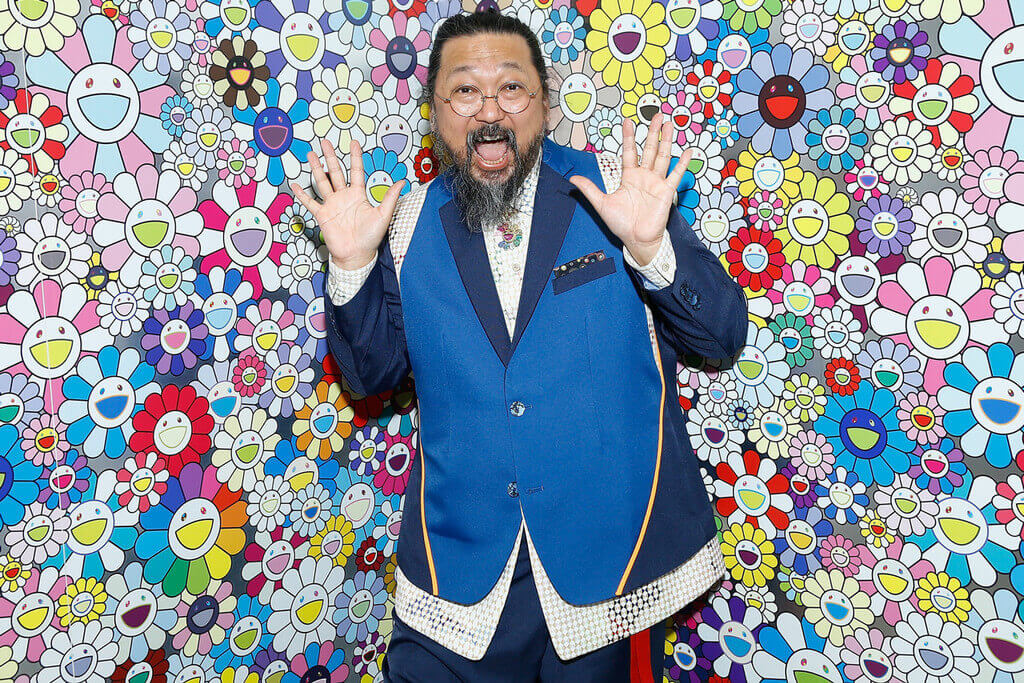
Out of this collision, Murakami founded the Superflat movement. Visually, Superflat emphasizes the two-dimensional, hyper-flattened perspective characteristic of classical Japanese woodblock prints (ukiyo-e) and modern animation. His art populates glossy, pristine canvases and massive sculptures with a recurring lexicon of characters. Most notable are his iconic smiling flowers, the whimsical yet mischievous duo Kaikai and Kiki, and his chaotic alter-ego, Mr. DOB—a Mickey Mouse-adjacent figure reflecting a culture oversaturated with commercialism.
The Power of Color: Joy, Traumascapes, and Kawaii
Central to the intoxicating energy of Murakami’s work is his mastery of color. His palettes are saturated, explosive, and unashamedly psychedelic. Using vibrant, neon-adjacent acrylics, Murakami doesn’t just catch the eye; he engineers a sensory overload. This deliberate use of color acts as a Trojan horse. On the surface, the bright, dizzying tones project a sense of pure kawaii (cuteness) and joy, pulling the viewer into a seemingly happy dreamscape. Beneath that sugary veneer, however, the overwhelming density of color masks undercurrents of anxiety, trauma, and psychological disquiet deeply tied to Japan’s post-nuclear history.
Bridging Worlds: From Louis Vuitton to the Streets
This fluid play between surface-level appeal and deep cultural resonance allowed Murakami to easily bridge fine art and consumer spaces. In 2002, at the invitation of Marc Jacobs, he famously revolutionized luxury fashion by splashing his multicolored, playful motifs across Louis Vuitton handbags, altering the brand’s visual history forever. He seamlessly adapted this strategy to the booming world of streetwear, collaborating with Supreme, printing t-shirts with Uniqlo, and designing album artwork for global pop icons like Kanye West and Billie Eilish.
It is exactly here—where the luxury runway meets the neighborhood skate shop—that all these elements converge into the deeply political engine of Murakami’s career. By blending Nihonga, pop merchandise, high fashion, and streetwear, Murakami acts as a great equalizer. To him, the rigid Western hierarchy that separates « high art » (prestigious, expensive, exclusionary) from « low art » (popular, mass-produced, accessible) is a pretentious construct meant to maintain class elitism.
The Great Equalizer: Art for a Universal Public
By commercializing his own work—turning multi-million-dollar museum motifs into $20 plush keychains, pins, and streetwear t-shirts—he conducts a deliberate act of subversion. He ensures that a teenager buying a t-shirt or an anime fan buying a toy can own the exact same artistic vision as a billionaire bidding at a Sotheby’s auction. In doing so, Murakami flattens society itself, leveraging the power of mass media to promote art for a universal public, and completely rewriting the rules of who gets to participate in contemporary culture.
Image source: Singulart